Leak detection in Scotland
Caledonian Leak Detection finds hidden water leaks in pipes, central heating systems and underground supply pipes across mainland Scotland, so walls, floors and ground are opened only where the leak is.

Illustration: a leak on a hot pipe behind a bathroom wall, as a thermal camera shows it.
Which leaks does Caledonian Leak Detection find?
Caledonian Leak Detection finds four kinds of leak: hidden pipe leaks inside the property, central heating leaks, underground supply pipe leaks and leaks traced for a home insurance claim.

- Pipe under the kitchen floor
- Radiator and heating pipe
- Ceiling below a bathroom
- Underground supply pipe
Illustration: four places hidden leaks occur in a tenement.
The cross-section marks where each one tends to hide in a sandstone tenement, from the pipe under the kitchen floor to the supply pipe beneath the front path.
Hidden pipe leaks
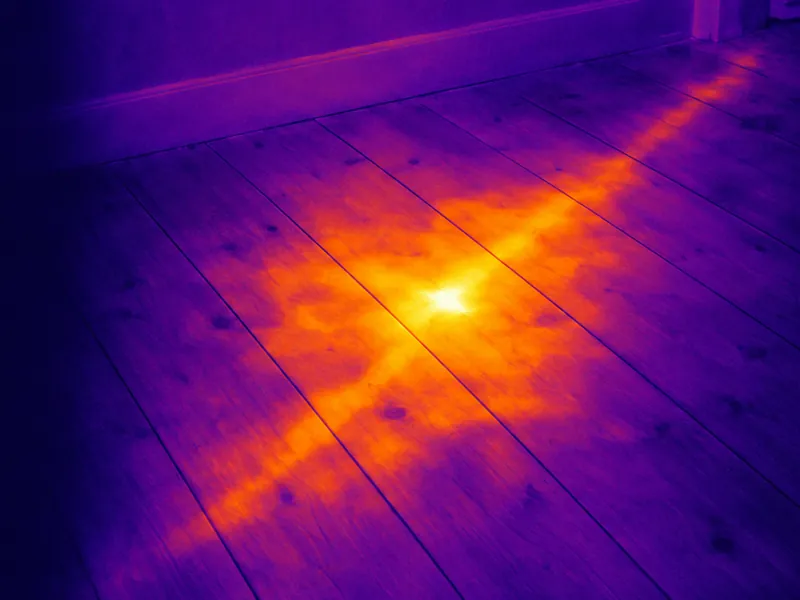
Water escaping from a hot or cold pipe under a floor or inside a wall usually shows up somewhere else first, and hidden pipe leak detection traces it back to the pipe before a single board is lifted.
- Where it hides
- Under floors, inside walls and ceilings, behind kitchen units and baths, and in pipes laid in concrete floors
- Usual signs
- A damp patch or stain on a wall or ceiling, a stain on the ceiling below, a musty smell or mould, warped floorboards, or running water with every tap off
- Methods used
- Pressure testing, thermal imaging, acoustic listening, tracer gas and moisture mapping
Central heating leaks
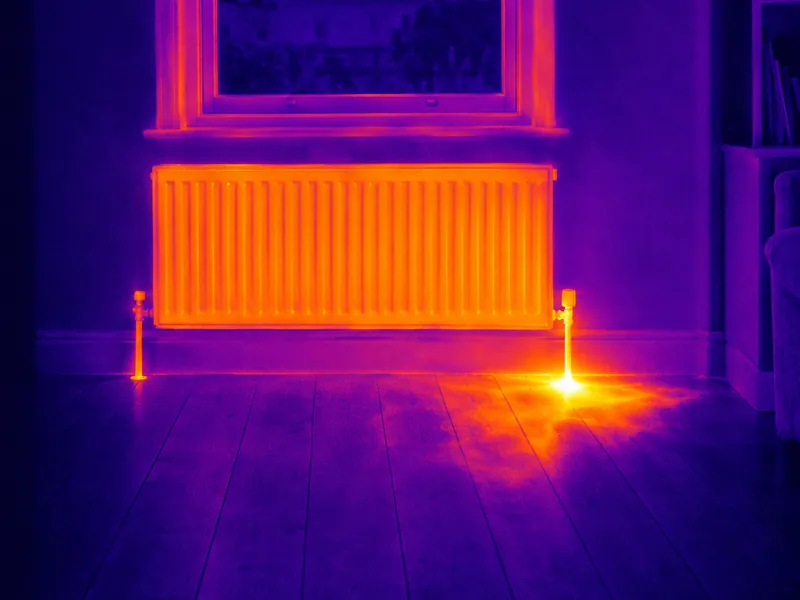
If the boiler gauge keeps falling and needs topping up, central heating leak detection tests the heating circuit and follows its pipe runs to the place where water is getting out.
- Where it hides
- Radiator pipework under floors and behind boxing, underfloor heating loops and the pipes around the boiler
- Usual signs
- A boiler pressure gauge that keeps falling below 1 bar and needs topping up, or damp spots and rust marks around radiators and along pipe runs
- Methods used
- Pressure testing, thermal imaging and tracer gas
Underground supply pipe leaks
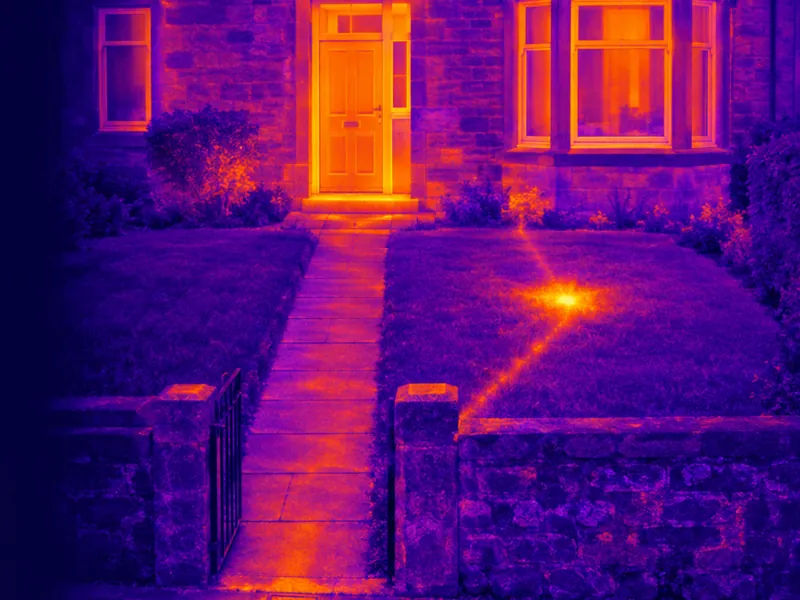
Between the stopcock at the boundary and the stop valve indoors runs a buried pipe the owner looks after, and underground supply pipe leak detection is how a leak along it is found from the surface.
- Where it hides
- The supply pipe between the stopcock at the boundary and the stop valve inside the property, under gardens, paths and driveways
- Usual signs
- Ground that stays wet or soft in dry weather, grass that grows greener, lower water pressure, or a hiss at the internal stop valve with every tap off. Often there is no sign at all
- Methods used
- Acoustic listening, tracer gas and pressure testing
Leaks traced for an insurance claim

For an insurer who wants the source of escaping water found before any repair, trace and access leak detection locates the leak and writes up where it is and what it takes to reach it.
- Where it hides
- Anywhere escaping water is damaging the home: ceilings below bathrooms, walls, floors and the flat below
- Usual signs
- A stain spreading through a ceiling or wall, and an insurer asking for the source to be found before repairs
- Methods used
- Whichever of the five methods the leak needs, with the findings written up for the insurer
What are the signs of a hidden water leak in a Scottish home?
A hidden water leak in a Scottish home usually shows itself as damp patches, stains, a musty smell, warped floors, the sound of running water, weak taps, a boiler losing pressure or ground outside that never dries.
Each sign below comes with what it usually points to, starting with the most common.
- Damp patches or brown stains on a ceiling or wall are usually the first giveaway, often with peeling paint or bubbling wallpaper around them.
- A stain on the ceiling below a bathroom or kitchen is worth checking early, because a leaking shower supply pipe, for example, can mark the ceiling of the room underneath.
- A musty smell or mould on a ceiling or an inside wall can mean water is reaching the plaster from a pipe you cannot see.
- Warped floorboards or water stains on the floor can mean a hidden pipe is wetting the boards from below.
- Running water or a hiss with every tap off may mean a leak on the supply pipe or the pipes inside, since nothing should be using water.
- Lower water pressure at the taps or shower can mean water is leaking out before it reaches the house.
- A boiler that keeps losing pressure usually points to a central heating leak, which Vaillant names as the most common cause, and one maker, Ideal, says topping up once a month or more could mean a small leak.
- Wet ground outside that stays soft in dry weather, or grass that grows greener than the rest, can point to a pipe leaking below it.
Just because the floor looks dry does not mean the pipe under it is sound: Scottish Water says most supply pipe leaks happen underground and leave no sign at the surface (source: Scottish Water, Leaks and Leakage FAQs).
How is a hidden leak found without opening floors at random?
A hidden leak is found with non-invasive methods that narrow it to one spot before any floor, wall or path is opened.
Each method reads a different clue (sound, surface temperature, gas, pressure or moisture), so the right one depends on what the pipe carries and what it runs under.
- Acoustic listening
- A listening stick on a pipe or fitting, or a ground microphone on the surface, picks up the noise of water escaping from a pressurised pipe, and the leak lies near the point where the sound is loudest.
- Suits Pipes under mains pressure, such as underground supply pipes, and pipework inside the property.
- Thermal imaging
- A thermal imaging camera shows the temperature of the surface it is pointed at, so water escaping from a hot pipe, central heating or underfloor heating shows as a warm patch, and damp can show as a cool one.
- Suits Hot water and central heating pipes, underfloor heating, pipes in concrete or tiled floors, and showing where damp has spread.
- Tracer gas
- The pipe is drained and filled with a mix of 5% hydrogen and 95% nitrogen, which escapes at the leak and rises through the floor or ground, where a hydrogen detector finds the highest reading.
- Suits Supply pipes, central heating and underfloor heating, and leaks too quiet to hear or too small to find another way.
- Pressure testing
- A system or a section of it is sealed, pressurised and watched on a gauge over a set time, and a part that will not hold its pressure normally has a leak.
- Suits Sealed central heating systems, underfloor heating loops (tested one by one) and water pipework, and confirming a suspected leak before anything is opened.
- Moisture mapping
- Moisture meter readings taken across a wall, floor or ceiling, often on a grid, show how far water has spread and where the material is wettest.
- Suits Walls, floors and ceilings wetted by a leak, including behind tiles and floor coverings.
No single reading settles it. A thermal image is confirmed with other checks, and a falling gauge on its own does not prove a leak, which is why one method's result is checked against another.
What happens during a leak investigation?
A leak investigation isolates the affected system, tests it for water loss, locates the leak with the methods that suit that pipe and marks its position before anything is opened.
Isolating the system to find which pipes are involved
The water supply, the hot and cold pipes or the heating circuit is identified and shut off on its own, so each part can be tested separately.
Pressure testing the pipework to confirm it is losing water
Sealed and pressurised, the isolated section is watched on a gauge over a set time; on underfloor heating every loop is tested in turn.
Tracing the leak with the methods that suit the pipe
Acoustic listening, thermal imaging, tracer gas or moisture mapping then narrow the search, chosen for what the pipe carries and what lies over it.
Marking the leak position to keep any opening small
Once the position is pinned down it is marked on the floor, wall or ground, so whoever opens it up cuts away as little as possible.
Writing up the findings for whoever repairs or pays
The owner, the plumber who puts it right, the landlord or factor, or the insurer gets the leak's location, the access work needed and photographs.
Who is responsible for a water leak in Scotland: you or Scottish Water?
Scottish Water is responsible for the pipes up to and including the stopcock, and you, as the owner, are responsible for the supply pipe from the stopcock to the property and everything inside it.
Scottish Water maintains the public water main, the communication pipe (the short length from the main to the stopcock), the stopcock itself and any water meter. The stopcock is the valve usually found near the property boundary, sometimes inside it.
The supply pipe (the pipe from the stopcock to the internal stop valve) belongs to the owner, together with every pipe inside the property, even where it runs beyond the boundary. Finding and repairing underground supply pipe leaks on that buried length is therefore the owner's job.
Where several homes share one supply pipe, the owners on it may be jointly liable. In a tenement the title deeds usually set out who pays for what; where they are silent, the Tenements (Scotland) Act 2004 supplies default rules, the Tenement Management Scheme. Copies of title deeds come from the Registers of Scotland.
If you rent, report the leak to your landlord or the owner, who arranges the repair.
Once a leak on a domestic supply pipe is detected, Scottish Water may offer an assisted repair or replacement. It is discretionary and conditions apply, so it is worth asking before the work is booked.
For a leak on the public main or at the boundary stopcock, Scottish Water is the first port of call. It takes reports online or on 0800 0778 778, 24 hours a day.
Sources: Scottish Water, Your guide to water pipework; Citizens Advice Scotland, Water leaks and pipes; Citizens Advice Scotland, Disputes about damages and repairs; Scottish Water customer leaflet; Scottish Water, I think I have a leak.
Does home insurance pay to find a hidden leak?
Many home insurance policies do, through trace and access cover, which pays to find where a hidden leak is coming from and to remove and replace the parts of the building needed to reach it. Some insurers also pay to put the home back as it was.
It does not pay to repair the leak itself. The cover is common in buildings insurance but far from universal, and contents-only policies rarely include it.
The policy wording decides the rest. Limits and excess vary by insurer and policy, and insurers differ in how they handle the search as well: some send their own specialist, some ask you to arrange one and claim the cost back, and some must agree before any work starts. That is why it is a good idea to speak to the insurer first, read the policy and keep every invoice and report.
Whatever the cost of tracing a leak turns out to be, whether the policy pays towards it comes down to that trace and access wording. Insurers ask for photographs and invoices, and the cause matters where it can be found, because policies exclude wear and tear and gradual damage.
Sources: Admiral, What is trace and access cover?; MoneySuperMarket, Trace and access cover.
Where in Scotland does Caledonian Leak Detection work?
Caledonian Leak Detection works across mainland Scotland, with its own pages for Glasgow, Edinburgh, Aberdeen and Dundee, and every covered postcode district is listed under areas covered.
Beyond the four cities, the main post towns include Paisley, Perth, Falkirk, Inverness, Kilmarnock and Ayr. In all, that is 382 postcode districts in 14 postcode areas, each one a dot on the map. Island districts are not covered.